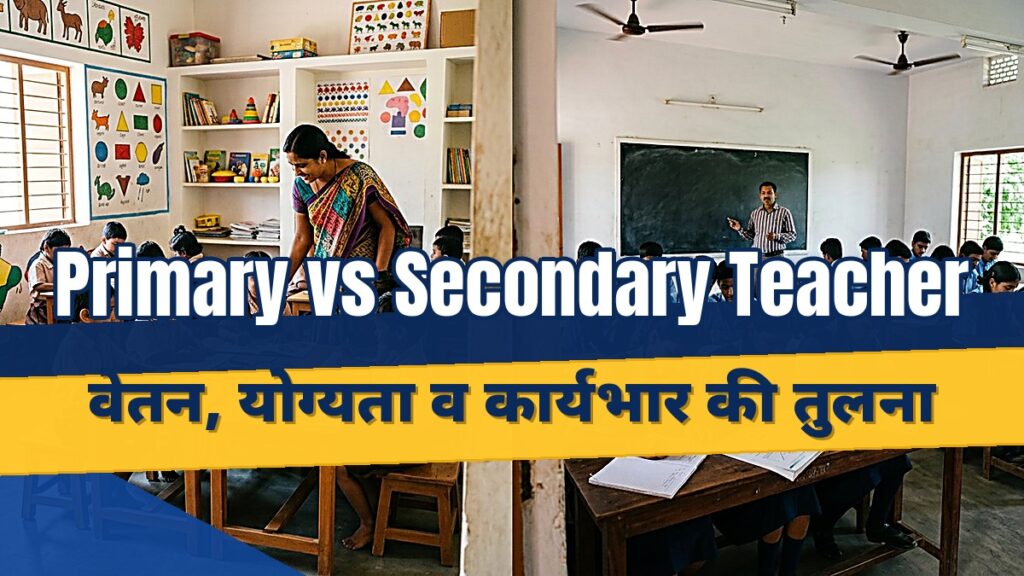
Primary teacher vs secondary teacher is not just a pay comparison, though pay is usually what prompts the question. The two roles differ in qualification route, pay level, the nature of daily classroom work, and how the career progresses over twenty years. Choosing well matters more than choosing fast. This comprehensive post covers all key updates regarding primary teacher vs secondary teacher.
Table of Contents
📌 Official Source & Editorial Verification
- Conducting Body: Madhya Pradesh Employees Selection Board (MPESB)
- Official Portal: esb.mp.gov.in / peb.mponline.gov.in
- Exam Category: MP Teacher Eligibility Test (MSPSTET / MPTET Varg 2 & Varg 3)
- Last Editorial Verification: 22 September 2026 (Verified with MPESB Official Updates)
Primary Teacher vs Secondary Teacher: Side by Side
Here is the detailed summary overview for primary teacher vs secondary teacher:
| Point | Primary Teacher | Secondary Teacher |
|---|---|---|
| Classes taught | 1 to 5 | 6 to 10 |
| Qualification route | 10+2 with D.El.Ed or D.Ed | Graduation in subject with B.Ed |
| Pay level | Lower pay level | Higher pay level |
| Subjects | Multiple foundational subjects | One or two subjects in depth |
| Classroom style | Holistic, activity based | Subject focused, exam oriented |
| Student age group | Young children | Adolescents |
| Eligibility paper | Varg 3 | Varg 2 |
Salary: Do Primary and Secondary Teachers Earn the Same?
No. Middle and secondary level posts sit at a higher pay level in the state pay matrix than primary level posts. The difference at entry is smaller than most people assume, but it compounds — through annual increments and through pay commission revisions, which apply as a percentage of basic pay. Over a full career, the gap becomes substantial.
The important nuance is that raising your level is not simply a matter of applying. The pay level follows the post, and the post requires the qualification. So the salary difference is really a qualification difference.
Detailed breakdowns are in our guides on MP primary teacher salary and MP middle and secondary teacher salary.
Workload: What the Job Actually Feels Like
| Aspect | Primary | Secondary |
|---|---|---|
| Number of subjects | Several, often all for one class | One or two, across several classes |
| Preparation load | Many subjects, lighter content depth | Fewer subjects, deeper preparation |
| Notebook checking | High volume, simpler corrections | Lower volume, detailed evaluation |
| Classroom management | Constant activity-based engagement | Adolescent behaviour and exam pressure |
| Board exam involvement | Minimal | Significant at classes 10 |
Teachers moving from primary to secondary often report that the work changes in kind rather than quantity. Fewer subjects means deeper preparation, but also more responsibility for board-exam outcomes and more complex classroom dynamics.
Career Progression
- Qualification gates the level. Adding B.Ed after a D.El.Ed route opens the secondary level, subject to the recruitment rules in force.
- Experience is transferable in spirit, not automatically in cadre. Years of primary teaching do not convert into secondary seniority by themselves.
- Departmental roles — headship, resource coordination — generally follow the cadre you belong to.
- Eligibility certification matters at each level. Our eligibility guide sets out the conditions.
How to Decide
- Look at the age group you are good with. This is the most under-rated factor. A teacher who is excellent with young children may find adolescent classrooms draining, and vice versa.
- Check your qualification honestly. The level you can enter is determined by your academic and professional qualification, not preference.
- Think long term on pay. The pay gap compounds over a career, but it is worth nothing if the work does not suit you for twenty years.
- Consider subject depth. Secondary teaching requires comfort with a specific subject. If you dislike advanced mathematics or science, the primary route is the better fit.
Candidates preparing for primary teacher vs secondary teacher should regularly verify official guidelines on esb.mp.gov.in.
Frequently Asked Questions
Do primary and secondary teachers earn the same in India?
No. Middle and secondary level posts sit at a higher pay level than primary level posts, so the pay differs at entry and the gap widens over a career through increments and pay revisions.
What is the difference between primary and secondary teacher qualification?
Primary level teaching typically requires 10+2 with D.El.Ed or D.Ed, while secondary level teaching requires graduation in the relevant subject with B.Ed or an equivalent qualification.
Is primary teaching easier than secondary teaching?
It is different rather than easier. Primary teaching involves more subjects, lighter content depth and heavier notebook volume, while secondary teaching involves fewer subjects with deeper preparation and more exam accountability.
Can a primary teacher become a secondary teacher?
Qualification is the gate. A primary teacher who completes the required qualification for the secondary level — typically graduation with B.Ed — can apply for secondary level posts and certification as per the recruitment rules in force.
Which level is better for a long-term teaching career?
It depends on your aptitude for the age group and your subject strength rather than on pay alone. The secondary level pays more over a career, but the primary level suits teachers who enjoy foundational, multi-subject teaching.
Official Links
- MPESB official website — esb.mp.gov.in
- Salary comparison — Primary teacher salary and secondary teacher salary
Qualification requirements and pay levels are governed by state rules and revised from time to time. Confirm current requirements from official sources.