Which degree is best for CA after 12th? As soon as the Class 12 board examinations end, the biggest dream of every ambitious student stepping into the world of commerce and finance is to add two magical letters — “CA” — after their name. But as soon as the student goes to register for CA Foundation on the ICAI portal, a big career dilemma stands before them: “Should I focus entirely on CA alone, or is it necessary to take admission in a regular college? And if I must choose a degree, then which path among B.Com, B.Com Honours, BBA or distance education will be the safest?”
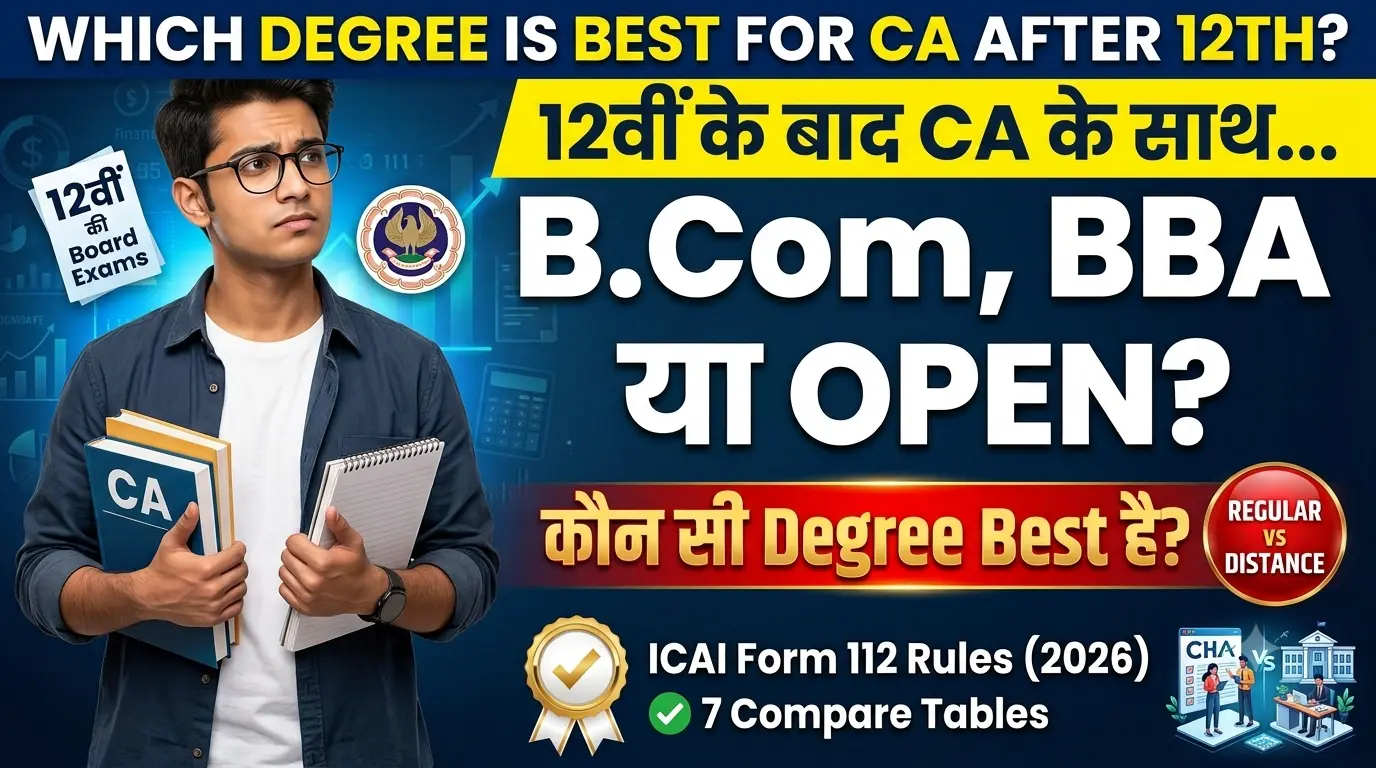
Which Degree is Best for CA After 12th? (Top Courses, Pros & Cons, and ICAI Rules)
Expert review: CA Academic Research Wing | Fact check: Senior Practising Chartered Accountant and Legal Advisor | Regulatory compliance: ICAI New Scheme of Education and Training (latest 2-year articleship guidelines)
Quick Answer
B.Com General (Bachelor of Commerce – Pass Course) is the safest, most practical and most recommended degree to do alongside Chartered Accountancy (CA). Do it through open or distance learning (like IGNOU or DU SOL) or a morning batch (7:00 to 10:30 AM) at a local college. Its syllabus overlaps 75% to 80% with CA Foundation and Intermediate.
Main reason: 75% to 80% of the B.Com syllabus directly matches the subjects of CA Foundation and Intermediate (Advanced Accounting, Corporate Law, Taxation, Costing and Auditing) 100%. In contrast, going for a regular B.Com Honours or BBA with strict 75% mandatory attendance creates a serious legal conflict with ICAI Form 112 at the time of Intermediate’s 8-10 hours of daily self-study and later the 2-year compulsory articleship.
It is often seen that school teachers or relatives advise without thinking that one should do B.Com (Hons) from a famous university because it carries great prestige in society. On the other hand, senior CA students give the frightening warning that if you go to a regular college, CA will never be completed because of attendance and projects. Such contradictory advice leaves new students confused, with the result that due to a wrong choice, students waste their precious 2 to 3 years.
Why Graduation Degree is Important Along With CA?
Many enthusiastic students think that when the Institute of Chartered Accountants of India (ICAI), established by an Act of Parliament, is India’s supreme accounting body, then why run after a degree from an ordinary university? Would merely passing CA not be enough?
In theory, this thinking may seem attractive. But in reality, preparing only for CA without any bachelor’s degree is like driving a car without a seat belt. Having a parallel degree is essential for every student for the following four mandatory reasons:
1. The reality of the passing percentage and the backup plan (The Safety Net). Chartered Accountancy is one of the country’s most prestigious but most difficult examinations. Moreover, the CA Foundation result is usually 20% to 25%. But by CA Intermediate and CA Final, it falls to 8% to 15%. Many times, even extremely meritorious students get trapped in the cycle of multiple attempts because they miss by 2-3 marks in one subject. If, for some unfortunate reason, a student at the age of 22 or 23 does not want to continue this journey, they should hold a government-recognised UGC degree. Without a degree, at that age you will only be considered “12th pass”, which will make even getting an ordinary executive job in the private or corporate sector impossible.
2. Conditions of higher education, IIMs and foreign universities. If later you want to do an MBA from IIM Ahmedabad, Bangalore or Calcutta by taking the CAT exam, note that their minimum eligibility criteria require a bachelor’s degree from a recognised university with at least 50% marks. Similarly, if in future you want to study Master of Finance (MS in Finance) from the London School of Economics (LSE) or top universities in America or Canada, those foreign institutions demand 3 or 4 years of formal college transcripts in addition to professional bodies.
3. Union Public Service Commission (UPSC) and government competitive examinations. In India, the minimum mandatory qualification to apply for government services like the Administrative Service (IAS), Police Service (IPS), Indian Revenue Service (IRS) or the Reserve Bank of India (RBI Grade B Officer) is to be a graduate from a recognised university. Even if you have half the CA qualification, without a formal bachelor’s degree you cannot even sign the application form for these national-level examinations.
4. The effect of balance in corporate recruitment and the Big-4. When, after passing CA Final, you sit for campus placements at Big-4 firms like Deloitte, PwC, EY or KPMG or at major multinational companies (MNCs), then the resume showing “B.Com + CA” or “BBA + CA” before HR signals a balanced personality. It proves that the candidate has successfully completed formal academic standards along with professional pressure.
Table 1: Degree Comparison Matrix
A direct evaluation of all options, based on students’ time, syllabus overlap, ease of articleship and mental stress, is given in the table below:
| Degree Course Name | CA Syllabus Overlap | Attendance Obligation | Conflict with Articleship | Best For Whom? |
|---|---|---|---|---|
| B.Com (Distance – IGNOU/SOL) | 80% (Extremely high) | Zero (0% attendance) | No conflict (100% easy) | Those who want to become CA in 1st attempt only |
| B.Com (General – Morning Shift) | 80% (Extremely high) | Medium (morning 7 to 10:30) | Easy (NOC easily available) | Those who want both a regular degree and college environment |
| B.Com (Honours – Regular Day) | 85% (highest) | Difficult (75% mandatory) | Extremely serious (time clash) | Those who want a top college’s brand and backup |
| BBA / BMS (Finance) | 45% (medium) | As per college (60-75%) | Medium to difficult | Those whose backup plan is MBA or startup management |
Which Degree is Best for CA After 12th? (In-Depth Course Breakdown)
After Class 12, students have many academic options. Let us analyse in detail the structure of each degree, its subjects, the time it demands and its harmony with CA.
1. B.Com General (Pass Course) — the best and safest option. If you ask any experienced CA teacher or All India Rank (AIR) holder, they will advise you without any hesitation to choose B.Com General (Pass Course):
- Natural overlap of 75% to 80% of the syllabus: The main subjects of all three years of B.Com General — Financial Accounting, Business Law, Company Law, Business Economics, Cost and Management Accounting, Auditing and Direct and Indirect Taxation — are the same ones you study in CA Foundation and Intermediate.
- Zero double study: When you spend 8 hours every day in coaching and books preparing for CA Intermediate Group-1 and Group-2, preparation for the college semester examinations happens on its own.
- Less academic mental stress: In the B.Com Pass Course, there is not that terrible pressure of daily assignments, PowerPoint presentations and complex project work that is seen in other colleges.
2. B.Com (Honours) — academically rich, but extremely stressful. B.Com Honours is considered the “Gold Standard” of graduation in India’s commerce world. If you are getting admission in the country’s top institutions (SRCC, Hindu College, Hansraj), only then consider it:
- Positive aspects: The college’s brand name, high-level networking exposure and the degree’s direct prestige in the corporate world.
- Ground reality and dangers: In these top colleges, the 75% attendance rule is enforced with full strictness. Staying in college from 8:30 AM to 3:30 PM and then watching the difficult CA class lectures in the evening exhausts students. Most students who go for regular B.Com Hons either give up their CA attempts or bring backlogs in college.
Table 2: B.Com vs CA Curriculum Subject-by-Subject Overlap
The table below makes it clear which B.Com subjects match 100% with the syllabus of which CA level:
| B.Com Semester Subject | Equivalent CA Subject | CA Level | Overlap % | Extra Preparation for College? |
|---|---|---|---|---|
| Financial Accounting | Accounting / Advanced Accounting | Foundation & Inter | 90% Overlap | Zero (Zero Effort) |
| Business & Corporate Law | Business Laws & Company Law | Foundation & Inter | 85% Overlap | Zero (Zero Effort) |
| Income Tax & GST | Taxation (DT & IDT) | Intermediate (Paper 3) | 85% Overlap | Zero (Zero Effort) |
| Cost & Management Acc. | Cost and Management Accounting | Intermediate (Paper 4) | 80% Overlap | Zero (Zero Effort) |
| Auditing & Ethics | Auditing and Ethics | Intermediate (Paper 5) | 75% Overlap | Zero (Zero Effort) |
| EVS / Hindi / English (AEC) | Not in CA curriculum | N/A | 0% Overlap | Read 3 days before the exam |
Table 3: Daily Time Budget Matrix
Where does a CA student’s time go in 24 hours? The comparison of the daily schedule of a regular college and an open university is given below:
| Activity | Regular B.Com Hons Student | Distance B.Com (IGNOU/SOL) Student | Direct Effect on Time |
|---|---|---|---|
| College classes & attendance | 6 to 7 hours daily | 0 hours (zero attendance) | Open student gets a direct lead of 6 hours |
| Travel time | 1.5 to 2 hours | 0 hours (study at home) | Complete saving from travel fatigue |
| CA Coaching lectures | 4 hours (with evening tiredness) | 4 to 5 hours (with a fresh mind) | Same coaching time |
| CA Self-Study & Question Practice | 1 to 2 hours (extremely inadequate) | 6 to 8 hours (ideal preparation) | The main difference for rank and 1st attempt |
| Sleep & health | 5 to 6 hours (mental stress) | 7 to 8 hours (healthy routine) | No risk of burnout |
Table 4: CUET Exam vs CA Foundation Timetable & Stress Matrix
The clash of dates of the CUET entrance exam and CA Foundation attempts for Class 12 pass students is given below:
| Month | Academic Activity | Stress Level | Recommended Priority |
|---|---|---|---|
| March – April | End of Class 12 board exams | Medium | Score 85%+ in Class 12 |
| May – June | CUET exam + CA Foundation June attempt | Extremely High | Give Law and Maths 3 hours daily |
| July – August | University college counselling & admission | Medium | Secure a seat in a morning or open college |
| September – October | CA Foundation September attempt / Inter beginning | Normal (controlled) | Start classes for both groups of CA Inter |
Table 5: Direct Entry Route vs Foundation Route
Is doing CA through Direct Entry after graduation better, or through the Foundation Route right after Class 12? The comparison of both routes is given below:
| Comparison Standard | Foundation Route After 12th | Direct Entry Route After Graduation | Best Option |
|---|---|---|---|
| Minimum educational eligibility | 12th board pass (any percentage) | 55% in Commerce / 60% in Non-Commerce | Foundation Route |
| Average age of becoming CA | 22 to 23 years (complete time saving) | 25 to 26 years (3-year delay) | Foundation Route |
| Study continuity (discipline) | Extremely high (the flow of Class 12 continues) | Weak (laziness sets in after 3 years of college) | Foundation Route |
| Intermediate passing success rate | Much better (base is strong) | Low (sudden shock of difficult syllabus) | Foundation Route |
Table 6: College Shift Feasibility Matrix
The possibility of getting ICAI Form 112 permission along with articleship (9:30 AM to 5:30 PM) in different college shifts is given below:
| College Type & Shift | Class Timings | Conflict with Articleship? | ICAI Form 112 Permission | Recommendation |
|---|---|---|---|---|
| Morning Shift College | 7:00 AM to 10:00 AM | No (completely different timings) | 100% easily approved | Highly Recommended |
| Regular Day College | 9:30 AM to 4:00 PM | Yes (direct time clash) | Rejected (100% Rejected) | Never choose with CA |
| Evening Shift College | 5:30 PM to 8:30 PM | Slight clash (in audit season) | Approved (on receiving NOC) | Good option (if the firm is nearby) |
| Open / Distance (IGNOU/SOL) | No daily classes | Zero (Zero Clashing) | Immediately approved (Auto-Approval) | 100% hassle-free (Stress-Free) |
Degree After 12th for CA Options
If for some reason the CA journey takes more effort or the plan has to change, alternative career paths are available on the basis of your graduation degree:
| Graduation Degree | Alternative Career Path | Additional Professional Course | Starting Salary Package (LPA) | Market Demand |
|---|---|---|---|---|
| B.Com General | Senior Accountant / Tax Executive | US CPA / US CMA / ACCA | ₹6.0 to ₹9.0 lakh | Extremely high (Global MNCs) |
| B.Com (Honours) | Financial Analyst / Equity Research | CFA (Chartered Financial Analyst) | ₹8.0 to ₹14.0 lakh | High (Investment Banking) |
| BBA (Finance) | Management Consultant / Product Manager | MBA (IIMs / Top B-Schools via CAT) | ₹16.0 to ₹28.0 lakh | Extremely high (Top Tier Corporate) |
| B.A. / B.Com LLB | Corporate Law Consultant / NCLT Litigator | CS (Company Secretary) / LLM | ₹12.0 to ₹20.0 lakh | Stable and premium (Legal Firms) |
Final Verdict: What is the Right Decision for You?
- If your 100% goal is only to become a CA in the first attempt: Without any hesitation, choose B.Com from Distance Education (IGNOU / DU SOL). You will get maximum time, mental peace and zero legal hurdles in articleship.
- If you want to balance college life and CA both: Choose B.Com General (Morning Shift – 7:00 AM to 10:30 AM) from a reputed college in your home town.
- If your primary backup plan is to do an MBA from an IIM: Choose B.Com (Honours) or BBA (Finance) from a top institution.
Official Information and Related Reading
For official information on the CA course, see the Foundation, Intermediate and Final course brochures on icai.org. Check registration and fees there as well.
Frequently Asked Questions
Can I do CA without any college degree after 12th?
Yes. Under ICAI rules, you can register for CA Foundation after passing Class 12, without any bachelor’s degree. However, a degree is strongly recommended as a safety net, because the CA Foundation result is usually only 20% to 25%, and by CA Intermediate and CA Final it falls to 8% to 15%.
Which is better with CA: B.Com or BBA?
B.Com is clearly better for CA preparation. Its syllabus overlaps 75% to 80% with CA Foundation and Intermediate, while BBA overlaps only about 45%. B.Com General and B.Com (Distance) overlap 80%, and B.Com (Honours) overlaps 85% — the highest of all.
Does ICAI allow regular college during CA articleship?
Yes, ICAI allows regular college during articleship, but you must submit Form 112 and get permission. A morning shift (7:00 to 10:00 AM) is approved easily, and open/distance learning (IGNOU/SOL) is approved immediately, while a regular day college (9:30 AM to 4:00 PM) directly clashes with articleship hours (9:30 AM to 5:30 PM).
Is a distance B.Com degree valid for corporate jobs after CA?
Yes. A distance B.Com degree from IGNOU or DU SOL is valid, and after becoming a CA, employers value the CA qualification and the degree together. A degree from a government-recognised university also keeps options open for UPSC exams, IIM MBA programmes and foreign universities.
What happens if I fail to submit Form 112 to ICAI?
If a student does not submit Form 112 to ICAI for college or any other activity during articleship, it creates a serious legal conflict with ICAI. You must get permission before starting college alongside articleship.
Which degree has the highest syllabus overlap with CA?
B.Com (Honours) has the highest syllabus overlap with CA at 85%. B.Com General and B.Com (Distance – IGNOU/SOL) follow at 80%, while BBA/BMS (Finance) overlaps only about 45%.
Can I choose a regular day college with CA?
A regular day college (9:30 AM to 4:00 PM) directly clashes with articleship hours (9:30 AM to 5:30 PM), and ICAI Form 112 permission is rejected for it. Choose a morning shift (7:00 to 10:00 AM) or open/distance learning (IGNOU/SOL) instead.
What is the minimum eligibility for the Direct Entry Route?
The Direct Entry Route needs 55% in Commerce graduation or 60% in Non-Commerce graduation. The Foundation Route after Class 12 needs only a Class 12 pass (any percentage).
Does the CUET exam clash with CA Foundation?
Yes. The CUET exam and the CA Foundation June attempt both fall in May–June, creating extremely high stress. The article recommends giving Law and Maths 3 hours daily in that period and securing a seat in a morning or open college in July–August.
What is the average age of becoming a CA through the Foundation Route?
22 to 23 years through the Foundation Route after Class 12, which saves time completely. Through the Direct Entry Route after graduation, the average age is 25 to 26 years — a 3-year delay.
Editorial verification: News Sarkari Results Editorial • Expert review: CA Academic Research Wing • Fact check: Senior Practising Chartered Accountant and Legal Advisor • Checked 7 November 2026 • Last updated: 7 November 2026
Leave a Reply