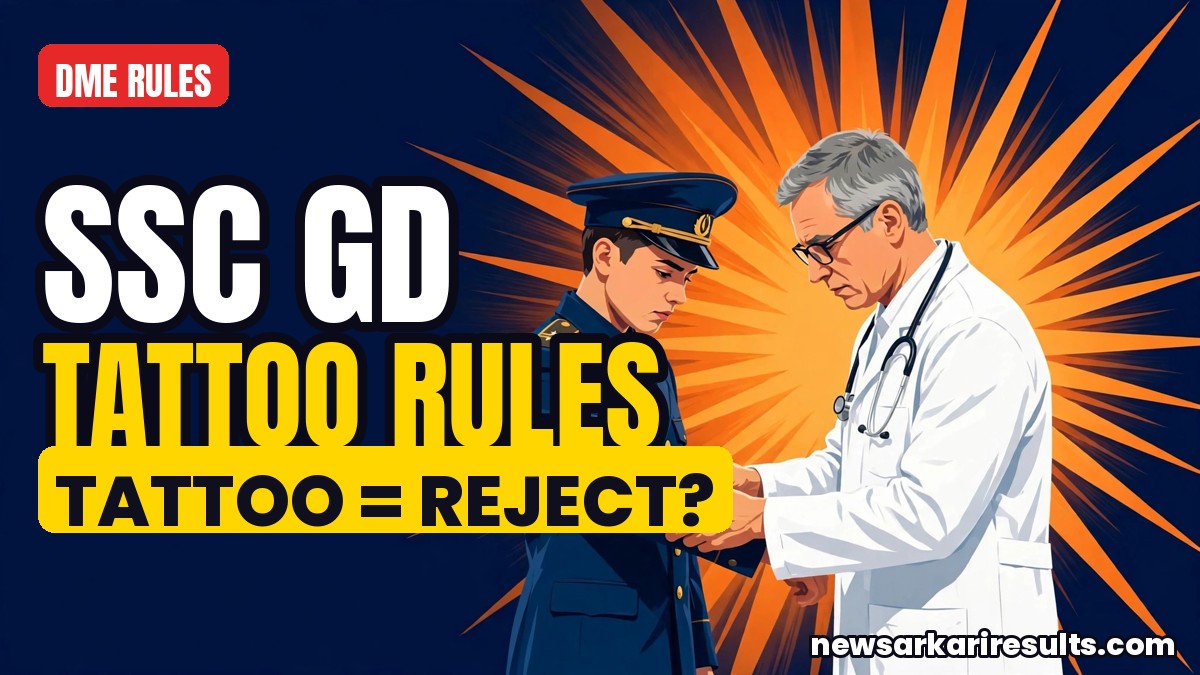
The SSC GD Tattoo Rules 2027 matter more than most candidates expect, because a tattoo that is not permitted can lead to rejection at the Detailed Medical Examination. This page covers the SSC GD tattoo rules 2027 allowed locations, size limit and DME process, so you can check your own tattoo before the medical stage. Start with the SSC GD 2027 Complete Guide if you need the notification, syllabus and physical standards in one place.
SSC GD Tattoo Rules 2027: Allowed Locations, Size Limit & DME Rules
Tattoos are allowed in SSC GD 2027 only for tribal candidates, and only as customary tattoos on the forearm or the back of the hand. Other candidates with a tattoo can be rejected at the Detailed Medical Examination (DME). Check your tattoo against the permitted locations below, declare it honestly, and carry your tribe certificate if you claim the exemption.
SSC GD Tattoo Rules 2027: What Is Allowed
Only one exemption opens the door. A customary tattoo can be permitted for a tribal candidate, in a permitted place. Everything else in the table below is judged the same way, so check your own case against it before the medical stage.
| Situation | Status |
|---|---|
| Tribal candidate with a customary tattoo on forearm or back of the hand | Permitted |
| Tribal candidate with a tattoo elsewhere on the body | Not permitted |
| Non-tribal candidate with any tattoo | Not permitted |
| Tattoo containing objectionable or obscene content | Not permitted for any candidate |
| Scar or mark from a healed tattoo removal procedure | Examined by the medical board and may be questioned |
Documents to Carry for the Tribal Exemption
Carry the proof with you. The exemption is not granted on your word alone, so keep these ready for the medical stage.
- A valid caste or tribe certificate issued by the competent authority.
- Any supporting document showing that the practice is customary in your community, if available.
- Photographs of the tattoo in case the board asks for a record.
What Happens at the Detailed Medical Examination
The board examines the whole body. If a tattoo is found, the board records its location, size and content, and then decides whether it falls within the permitted exception. Candidates are advised to declare their tattoo in advance rather than allowing the board to discover it, because concealment itself raises doubts about eligibility.
Common Reasons for Medical Rejection
A tattoo is only one of them. The medical stage also rejects candidates for other conditions, so check the full list before you appear.
- Tattoo on the arm, neck, face or hand other than the permitted area.
- Tattoo with objectionable content, gang symbols or obscene design.
- Knock knees, flat feet or old fracture with deformity.
- Defective colour vision, poor distant vision or hearing defects.
- Hernia, hydrocele or varicose veins, which are usually treated as temporary disqualifications.
How to Prepare Before the Medical Test
Prepare early, not at the last minute. A little work before the DME can save you a rejection you could have avoided.
- Read the medical standards in the official notification and compare them with your own condition.
- If you have a temporary condition such as an infection, get it treated well before the DME.
- Carry all original certificates, including the tribe or caste certificate if you are claiming the tattoo exemption.
- Do not attempt laser removal close to the examination date – fresh marks can raise questions with the medical board.
Allowed vs Not Allowed: Full Table
Location decides most cases. The forearm, the upper arm and the back of the hand are the locations the board accepts, while the face, neck, chest and head area are not.
| Location | Status | Notes |
|---|---|---|
| Forearm, inner or outer | Allowed | The most commonly accepted location |
| Back of the hand | Allowed | Subject to no objectionable content |
| Upper arm | Allowed | Not applicable |
| Face, neck and chin | Not allowed | Grounds for rejection |
| Chest | Not allowed | Hidden under uniform but still checked |
| Behind the ear | Not allowed | Treated as head area |
| Religious or tribal symbols | Allowed as per exemption | Depends on community and region |
A tattoo removed by laser still leaves a scar.
North-East Tribal Exemption
The exemption follows your community, not the map. Candidates belonging to tribal communities of the North-Eastern states and other notified tribal areas can claim the exemption for a customary tattoo, subject to the permitted locations and the documents below.
- The exemption is community-based, not location-based.
- Documentary support matters along with the medical form.
- Customary tattoos can still be checked for objectionable content.
How Tattoos Are Checked at DME
The check is thorough. Do not assume a tattoo the uniform covers will go unnoticed, because the board looks at the whole body.
- The medical board inspects visible areas first, such as the face, neck and hands.
- Areas covered by clothing get checked inside the medical examination hall.
- The board records the location, size and content of each tattoo.
- Tattoos visible above the uniform at the neckline, or on the head, fail.
- The candidate may be asked to submit a declaration matching the application form.
If Your Tattoo Is Rejected
A rejection is recorded, not argued on the spot. If the board finds your tattoo is not permitted, this is what happens next.
- The decision of the medical board gets recorded in the DME form.
- An appeal against the medical finding follows the procedure printed in the notice.
- A tattoo decision cannot be re-examined, only challenged through the appeal route.
- Declaring the tattoo honestly in the application avoids a later mismatch finding.
Tattoo Size, Design and Content Rules
Location is not the only test. Even in a permitted area, the size and the content of a tattoo matter, and a large or offensive design can still draw scrutiny.
| Aspect | Rule applied |
|---|---|
| Location | Only forearm, upper arm and the back of the hand can apply |
| Size | Should be modest, a large tattoo covering the whole forearm invites scrutiny |
| Content | Anything obscene, communal, or offensive to any community fails outright |
| Text | Names and short text are usually accepted, slogans on sensitive subjects are not |
| Colour | Colour is not a disqualification by itself |
| Number | Multiple tattoos in permitted areas are generally allowed |
The medical board records what it sees and then the decision is taken as per the notice.
Commonly Rejected Locations With Examples
Hidden does not mean safe. Candidates usually believe that anything hidden under a shirt is safe, but the medical examination checks the whole body, including areas covered by clothing.
| Location | Why it fails | Example |
|---|---|---|
| Face | Visible and expressly barred | A small design on the cheek |
| Neck and throat | Visible above the collar | A name written on the side of the neck |
| Behind the ear | Treated as part of the head | A tiny star behind the ear |
| Chest | Not a permitted location | A large design on the chest |
| Forehead or scalp | Head area, not permitted | A religious symbol on the forehead |
| Inner wrist extending to the palm | Considered beyond the permitted forearm area | A bracelet-style band crossing the wrist |
Tattoo Declaration at the Application Stage
Declare it in the form. Most GD application forms ask whether the candidate has any body tattoo, and the declaration gets checked at the medical stage.
- Read the tattoo question in the application carefully before answering.
- Declare any tattoo, even in a permitted area, rather than leaving it out.
- If the tattoo is customary for a notified tribal community, mention that in the declaration.
- Carry photographs of the tattoo along with the community certificate for the medical stage.
- If you later get a tattoo removed, keep the dermatologist’s certificate or the treatment record.
A mismatch between the declaration and the medical finding is treated seriously.
Removal and Cover-up: What Works and What Does Not
Removal is not a quick fix. Every option below leaves something the board can see, so weigh it before you spend money on it.
| Option | Does it help? | What to know |
|---|---|---|
| Laser removal | Partially | Removes the ink but often leaves a faint scar or pigment change |
| Surgical removal | Rarely advisable | Leaves a scar, which the board may record |
| Cover-up tattoo | Does not help | Creates a larger tattoo in the same place |
| Make-up or camouflage | No | The examination happens under proper lighting and would count as concealment |
| Skin graft | Medically risky | Not accepted as a solution |
The realistic position is this: if your tattoo is in a permitted location, declare it and carry on preparing.
Other Medical Checks at the Same Examination
The tattoo check sits alongside the rest. The same medical stage tests your vision, teeth, hearing, heart, lungs, orthopaedic fitness and blood pressure, so a tattoo is not the only thing to prepare for.
| Check | Standard applied | Common issue |
|---|---|---|
| Vision | 6/6 in the better eye and 6/9 in the worse eye, no colour blindness | Uncorrected vision below the standard, or colour vision deficiency |
| Teeth | At least 14 healthy teeth in each jaw | Untreated decay, missing teeth, orthodontic braces not completed |
| Hearing | Normal in both ears | Wax blockage or untreated infection |
| Heart and lungs | Normal on examination | Undiagnosed conditions found for the first time |
| Orthopaedic | No flat foot, knock knee, bow legs or varicose veins | Flat foot and varicose veins are the most common findings |
| Blood pressure | Within the normal range | White-coat hypertension, which usually rechecked |
Get a general health check-up a few weeks before the medical stage.
Documents to Carry for the Medical Stage
Keep the file complete. Missing papers at the medical stage cause delays you do not need, so pack these before you travel.
- Admit card and call letter for the medical examination.
- Photo identity proof, plus photographs in the same format as the admit card.
- Medical history declaration, if the notice asks for one.
- Prescription and treatment records for any past illness or surgery.
- Spectacle prescription, if you use glasses.
- For tribal tattoo exemption: community certificate in the prescribed format.
- For any earlier injury: hospital records and discharge summary.
Tattoo Rules in Other Recruitments: How GD Compares
Other forces are broadly similar. Candidates often apply for the state police, CAPF and defence entries in the same year, and the tattoo rules are broadly similar, but the details differ from one force to another.
| Recruitment | Tattoo position | Usual practice |
|---|---|---|
| SSC GD (CAPF) | Barred on face, neck, head and chest | Forearm, upper arm and back of the hand allowed |
| State police constable | Similar restrictions in most states | Some states allow forearm tattoos only |
| Agniveer (Armed forces) | Permitted in specified areas | Tribal and religious exemptions recognised |
| Central armed police officer (UPSC) | Same medical framework as CAPF | Checked at the medical board stage |
| Assistant commandant entries | Same framework | Consistency with the force’s medical rules |
If you plan to apply to several recruitments, keep every tattoo in the safest possible location.
A Five-Minute Decision Table for Your Own Tattoo
Find your own case in this table. It does not replace the medical board, but it tells you what to do next for the tattoo you have.
| Your situation | What to do |
|---|---|
| Tattoo on the forearm, small, not offensive | Declare it in the application form and carry on preparing |
| Tattoo on the upper arm or back of the hand | Declare it, it is permitted under the standard rules |
| Tattoo on the wrist extending to the palm | Get a medical opinion before the cycle, part of it may be outside the permitted area |
| Tattoo on the chest, though covered | Declare it. Covered does not mean exempt; the medical board examines the body |
| Tattoo on the face, neck or head | Start removal treatment now and keep every record, get ready for rejection in this cycle |
| Customary tribal tattoo | Carry the community certificate and a declaration, the exemption applies to your community |
The final decision rests with the medical board, not with any online forum.
Frequently Asked Questions
These are the questions candidates ask most often about SSC GD Tattoo Rules 2027, answered from the facts in this guide.
Are tattoos allowed in SSC GD?
Tattoos are permitted only for candidates of tribal communities as per tribal custom, and only on the forearm or back of the hand. For other candidates, a tattoo generally results in rejection at the medical examination.
What if I have a tattoo on my hand or neck?
A tattoo outside the permitted locations is a disqualification under the medical rules, regardless of its size.
What documents are needed for the tattoo exemption?
A valid tribe or caste certificate from the competent authority, and any document that shows the tattoo follows the custom of your community.
Can I remove my tattoo before the medical test?
Removal is not a guaranteed solution, and fresh marks from removal are examined by the medical board. The safer course is to apply only if your tattoo falls within the permitted exception.
Does a tattoo affect the PET or PST?
No. Tattoo rules apply at the Detailed Medical Examination stage, not during the physical tests.
Is there any size limit for an allowed tattoo?
The rules focus on the location and the tribal exemption rather than a fixed size limit, but the medical board examines whether the tattoo is customary and whether its content is objectionable.
Can I hide my tattoo under the uniform in SSC GD?
No. Tattoos in prohibited areas visible above the uniform, or on the head, get checked and can lead to rejection.
Do tribal candidates get a tattoo exemption in SSC GD?
Yes. Candidates from notified tribal communities are exempt for customary tattoos, with documentary support at the medical stage.
Is a tattoo on the forearm allowed in SSC GD?
Yes. Forearm tattoos are permitted, provided the design is not objectionable, and they should still be declared in the application form.
Can I get a tattoo removed after applying for SSC GD?
You can, but keep the dermatologist’s records. Removal often leaves a scar, and the medical board records scars in prohibited areas as well.
Related Job Hubs
Browse all 40 job hubs: All Job Hubs – jobs by qualification, sector and state
Related new hubs: Government Job Document Checklist. Government Result Check Guide. Agniveer Recruitment 2026.
Final Checklist Before You Apply
- Confirm your eligibility against the official notification once it comes out.
- Keep scanned Class 10 marksheet, photo, signature and category certificate ready.
- Complete One Time Registration (OTR) on ssc.gov.in before the application window opens.
- Apply early and verify the submitted form before the closing date.
SSC GD 2027 – Related Guides
- SSC GD 2027 Complete Guide – notification, syllabus, physical standards and salary in one place
- SSC GD Vacancy 2027 – state-wise, force-wise and category-wise break-up
- SSC GD Physical Test 2027 – Height, Chest, Running Standards
- SSC GD Selection Process 2027 – CBT, PET/PST, DME & DV
- SSC GD Full Form – GD Constable, CAPF Forces & Salary
Official Sources
Last updated: 7 November 2026. Figures marked indicative are from the last SSC GD cycle and may change with the 2027 notification. ssc.gov.in